28 Days of Prayer Devotionals
DEEPER PRAYER:
A Chronological Journey Through the Depths of Paul's Prayers That Will Deepen Your Prayer Life
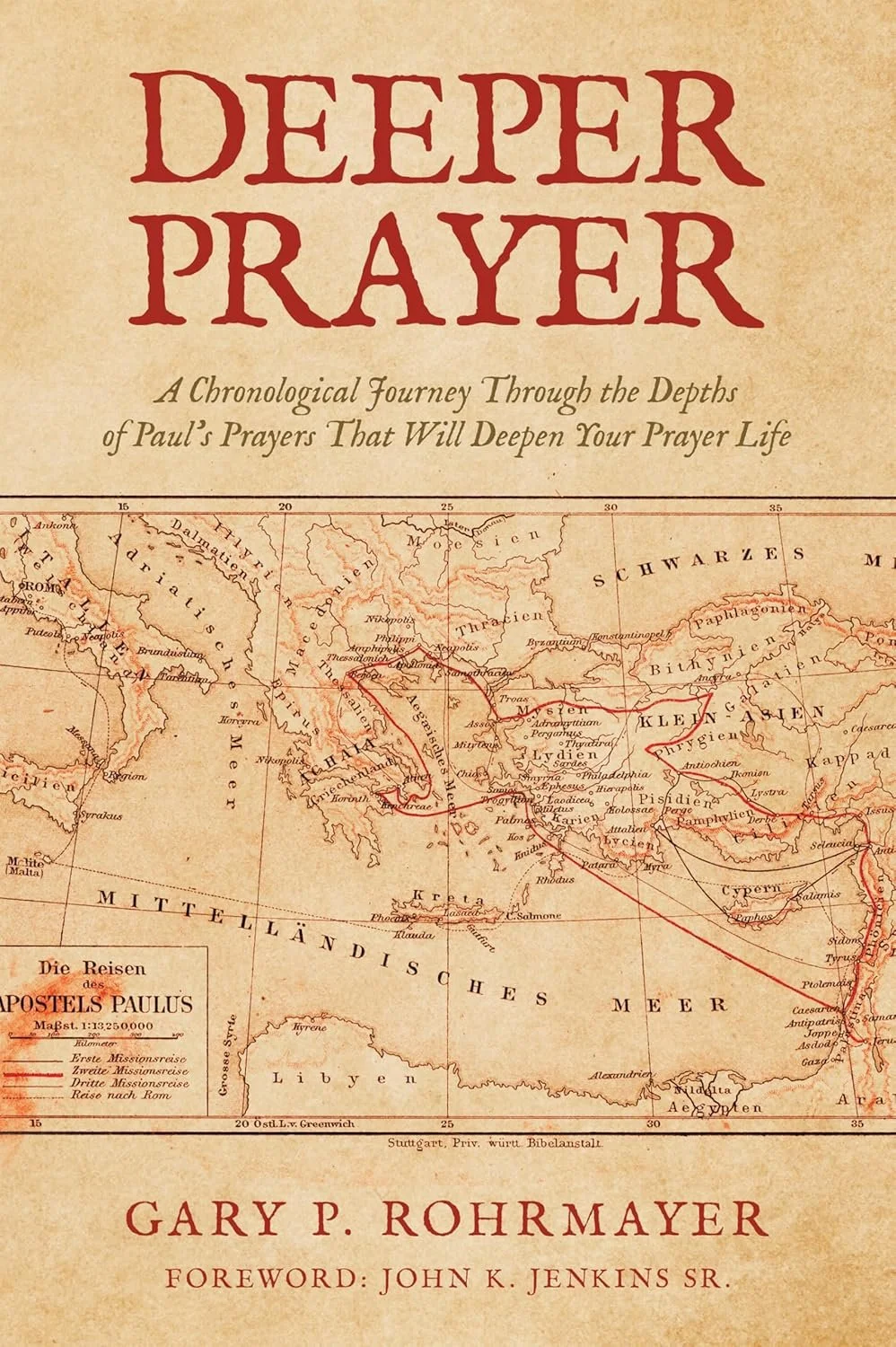
This devotional, Deeper Prayer: A Chronological Journey through the Depths of Paul’s Prayers That Will Deepen Your Prayer Life, serves as a twenty-eight day prayer guide that allows you to walk alongside Paul as he travels through his missionary journeys, encouraging the churches and communities he served. It explores the courage, wisdom, and insight that propelled the early church’s expansion and shares how you can unleash the same transformative power in your life through the truths revealed in these prayers.
Author Gary Rohrmayer offers a path to spiritual growth and a deeper understanding of the immense power of prayer. This captivating exploration of Paul’s prayers and their enduring impact gives valuable insights and will help you access the same spiritual authority that fueled Paul’s ministry. Deeper Prayer provides a pathway for your spiritual growth and a profound appreciation for the effectiveness of a rich and deeper prayer life.
Practical Advice for Doing a 28-Day Prayer Campaign
Devote one month to this Prayer Initiative – Fall (August, September, or October) or Winter (January, February, or March).
Preach a four-week sermon series on prayer:
Sermon #1 – Introduction to series and 28-day devotional book.
The next three sermons can be ideas from the book to reinforce it in the lives of your people.
Read the Article – Ten Practical Steps to Creating Momentum with your team and see how to maximize your efforts.
Invite your team to courageously pray for friends and family far from Jesus.
Have them generate a list of 5 friends or family to pray for during the 28 days.
Invite your team to courageously pray for a list of church-wide prayer goals.
Have your leadership team develop 5-6 prayer goals for the church and its members to pray for during the 28 days. Example prayer goals include:
Pray for a revival to break through our church.
Pray for a spiritual awakening to happen throughout our community.
Pray for the youth outreach initiatives, retreats, and camps.
Pray for our pastoral staff that God would empower them (Ephesians 3:15).
Pray for the following cities as we seek to see a new church started there and see God’s kingdom expanded.
Pray for our missionaries that God will favor them and make them effective in their work (list the missionaries by name).
Hold a series of corporate prayer meetings or a concert of prayer.
Purchase the Deeper Prayer books at a discount to give out free to your people, or have them make a donation of $6.00 to cover the church’s expenses. Encourage those Amazon Kindle users to make purchases directly through Amazon.
Consider having Gary Rohrmayer speak on a Sunday during your series. Email us to check availability.
DEEPER PRAYER Sermon Ideas
4 Week Series
-
Text: Acts 17:1-10; I Thessalonians 1:1-10
John Piper said years ago, “Books on prayer are like books on marriage”. They help point the way to a marriage relationship, but the reality of marriage is only discovered and experienced in the act of marriage. The day-to-day grind of loving and being loved, forgiving, and being forgiven, serving, and being served over year by year with a joy in our hearts and resolve in our spirits.
Every relationship is built on two simple ingredients: talking and listening.
Learning how to express yourself to another person is critical any relationship. None of us have glass heads so that people can see our thoughts or have the psychic ability to read each other’s minds. People are trusting us to communicate what is going on in our heads. They are relying on us to share with them our thoughts, ideas, feelings, perspectives, and beliefs.
Mastering the art of listening takes a lifetime because it involves tuning into someone else reality. Most of us listen to reply to someone and not to get into their reality. To really listen is to see the world from their perspective, to feel their experiences from their vantage point. This is a level of listening that few of us ever achieve. Yet when we do it revolutionizes our relationships through what I love to call “Ah Ha” and “Oh No” moments.
How is intimacy achieved? Through years and years of talking and listening.
Prayer like marriage is learned by the act of communing with God. It is learned by talking and listening to God. Talking to God in prayer and listening to God speak through his written Word by the Holy Spirit.
Paul's relationship with the church in the city of Thessalonica was nothing but miraculous. Paul and Silas entered the town and went directly into the Jewish synagogue. For the next three weeks, they began explaining and proving from the scriptures that Jesus was the Messiah (Acts 17:1-3). This proclamation of the gospel resulted in some of the Jews being persuaded, along with many God-fearing Greeks and quite a few prominent women (Act17:4). This group of new Christ-followers joined Paul and Silas and the church in John Piper, Thessalonica was born! And yet, what happens next was not uncommon for Paul and his companions. The Jewish leaders, out of jealousy, formed a mob to attack them. They stormed into the home of Jason (one of their converts), not finding Paul and Silas. The mob brought Jason and other believers to the city officials, citing their concerns. "These men who have caused trouble all over the world have now come here, and Jason has welcomed them into his house. They are all defying Caesar's decrees, saying that there is another king, one called Jesus" (Acts 17:7-8). That evening, these new believers help Paul and Silas escape the city and escorted them to Berea (Acts 17:10).
Now two years later, Paul writes his first letter to them. He immediately offers words of thankful praise to the God who saved them and established them as a church in only three weeks. No wonder Paul was filled with awe and profound gratitude.
What can we learn from this first prayer expressed from Paul's pen?
First, his prayer life was filled with thankful praise. "We always thank God for all of you" (v.2). As we will see, this will be a prominent theme in most of Paul's written prayers to the churches. G. K. Chesterton wrote, "gratitude is happiness doubled by wonder." We see Paul's heart was 'doubled by wonder.' As he rejoices in the miraculous work of God done in the hearts of those early converts in Thessalonica. Their hearts were not only powerfully changed by the power of God's Spirit, but they were knit together to form a new community of faith. I can imagine Paul, upon hearing the good report of the church in Thessalonica, saying to himself, "Only God, only God could have done this. Thank you. Thank you. Thank you." To really be thankful, you need a sense of wonder, awe, and amazement in your relationship with God. Seeing God in the little things as well as the big things is key to making one's heart grateful.
Second, he prayed specifically for God's people. He writes, "continually mention you in our prayers" (v. 2). Paul and his team verbally brought to the Father the believers in Thessalonica in a spirit of worship. The word used here for prayer is commonly used in the context of worship. It is in this context that Paul and his companions were interceding for the Thessalonians. Some would say that Paul had a growing prayer list that he used to pray specifically for the churches and friends in his ministry. This phrase 'making mention' was used for the church in Rome (Romans 1:9), the church in Ephesus (Ephesians 1:16), and his friend Philemon (Philemon 1:4). Showing that this was a habitual practice in Paul's life. Do you have a written prayer list? A list that helps you to pray specifically for the needs of your family, friends, and fellow believers around the world. These prayer lists, over time, eventually become a praise-list reflecting God's mercy in answering our prayers.
Third, Paul thankfully worships God for his supernatural work in their lives. When Paul prayed for the Thessalonians, he remembers explicitly the strong virtues that marked their lives. Their work, labor, and endurance. He recalled that these virtues were not something they naturally possessed but were born spiritually from their relationship with Jesus. He says their "work produced by faith," their "labor prompted by love," and their "endurance inspired by hope in our Lord Jesus Christ" (v.3). Only God has the power to change the human heart. In a spirit of thankful praise, Paul recognizes and confirms the supernatural work of God in their lives. He tells them that they were loved and chosen by God and that the Holy Spirit mightily revealed the truth of the gospel to them. They received the message with joy even during great persecution. In this, they became great models of the faith and ambassadors of the message. Their testimony rang out all over the region as people reported. Paul writes, "They tell how you turned to God from idols to serve the living and true God, and to wait for his Son from heaven, whom he raised from the dead—Jesus" (vs. 9-10). Too many times, we think of prayer as asking, asking, and asking. And yet, the highest form of prayer involves giving, giving, and giving. Giving thanks, giving worship, and giving glory to the God who loves us. In his first prayer, Paul teaches us the importance of thankful praise. May thankfulness dominate our prayer lives just like Paul. May our hearts be doubled by the wonder of gratitude. May the amazement of thanksgiving cause us to go deeper in prayer. Why is it, then, that we are not more thankful? The truth probably is that we don’t stop to think. The cares and riches and pleasures of this life choke the plant of gratitude, and our lives become unfruitful. Thanksgiving is thus really the product of careful cultivation. It is the fruit of a deliberate resolve to think about God, ourselves, and our privileges and responsibilities. By giving thanks, we make manifest the fact that our lives are not controlled by the imperious cares and concerns of this life. We give testimony to the fact that material things do not dictate the horizons of our soul but that our lives, our labors and our destinies are in the hands of a Sovereign God who loves us more than we realize.
Father in Heaven, thank you for the supernatural work you do in me and through me. You made my heart come alive by the power of your Spirit. You turn my life from worshiping man-made trinkets to worshiping the living God. Father, thank you for the spiritual blessings I have in Christ, and may my testimony ring out to the world around me. In the name of Jesus, Amen.
-
Text: 1 Thessalonians 2:17-3:13; I Thessalonians 5:16-24
Prayer #1: A TIRELESS PRAYER FOR SANCTIFICATION
1 Thessalonians 2:17-3:13
Introduction
Christie’s Twenty-Nine-Year Prayer Vigil
Christie came from a religious family but lacked a personal Christian faith until her freshman year in college, and she immediately became her family’s “prayer warrior.” What followed was a testament to relentless intercession. Her brother became a Christian after 15 years of her prayers and witness. Her mother trusted Christ 19 years after Christie began praying. Her father was saved at age 83—29 years after Christie’s prayers for her family members began.
The remarkable aspect of Christie’s story is not merely the duration of her prayers, but her refusal to surrender to discouragement. In her early Christian life, Christie dragged her parents to multiple Christian meetings, thinking this would be the perfect moment for their conversion, but they never became Christians. Yet she persisted. She persevered, continued to share, included them in her spiritual journey, and introduced them to her friends and brought them to hear Paul preach. They both finally came to faith after two decades of Christie living out her Christian life before them and helping them through great physical crises.
Christie’s story illustrates Paul’s pattern in 1 Thessalonians—tireless intercession that refuses to accept spiritual stagnation in those we love, whether the answer comes in months or decades.
Let’s look at the first of two prayers Paul tirelessly made on behalf of this infant church:
1 Thessalonians 2:17-3:13
The church in Thessalonica had a special place in Paul's heart. His profound sense of affection for them is unmistakable in this letter. He describes his painful separation from them as being orphaned, which created a deep longing for them (v. 17). Again, Paul's strong words describe how important they are to him. "For what is our hope, our joy, or the crown in which we will glory in the presence of our Lord Jesus when he comes? Is it not you?Indeed, you are our glory and joy" (vs.19-20). When Paul faces the judgment seat of Christ, he will lay the Thessalonian church at the feet of Jesus because they are his "glory and joy."
Paul's passion for these new believers is filled with unmatched warmth, which drove him to pray unceasingly for them. He writes, "Night and day we pray most earnestly…" (I Thessalonians 3:10). "Night and day" is a phrase laborers in Paul's day used to describe their tireless work, and the words "most earnestly" basically mean above and beyond. In essence, Paul is saying, "I am tirelessly laboring above and beyond for you in my prayers." Do we have people in our lives that we are tirelessly praying for above and beyond the call of duty? The key to a deep spiritual life is prayers that are diligent and exceeding in nature.
Let's look at the two tireless prayers for sanctification Paul makes on behalf of this church:
First, he prayed to be with them in person. "Now may our God and Father himself and our Lord Jesus clear the way for us to come to you" (v. 11). Paul loved this new church so much that he continued presenting this request before the throne of God. His longing to have face-to-face contact with them constantly drove him to his knees. His prayer went unanswered for five years when he finally visited them on his third missionary journey (Acts 20:1-4). I find hope in this that even the Apostle Paul struggled with unanswered prayer. Yet, it did not stop him from voicing his desires to the Lord, night and day, until they were answered.
Hang here … do you struggle with unanswered prayer? Does the enemy just attack your thoughts on this matter…
Second, he prayed that their hearts would grow in love. "May the Lord make your love increase and overflow for each other and for everyone else" (v. 12). Love is the supreme value every church should possess in an overflowing manner. Paul reminds them of this later in the letter when he writes, "Now about your love for one another we do not need to write to you, for you yourselves have been taught by God to love each other. And in fact, you do love all of God's family throughout Macedonia. Yet we urge you, brothers and sisters, to do so more and more…" (I Thessalonians 4:9-11). Paul recognizes that they are a loving church, yet he challenges them to take it to another level. We as God's people must continually be growing and stretching ourselves in love, for each other, and for everyone in our world. This is the essential mark of a follower of Jesus (John 13:34-35). If there ever was a time for the church to be overflowing with love, it is today! Amid political conflict, racial tension, and constant strife, the church has an opportunity to be a powerful example of God's infinite love for our world. May it be so.
Third, he prays that they may find inner strength from God to lead a holy life. "May he strengthen your hearts so that you will be blameless and holy in the presence of our God and Father…" (v.13). God saved us from a life polluted by sinful impulses and now gives us the power through his Spirit to tame those desires. This is the process theologians call sanctification. Paul addresses this issue head-on in the following chapter. "It is God's will that you should be sanctified: that you should avoid sexual immorality; that each of you should learn to control your own body in a way that is holy and honorable, not in passionate lust like the pagans, who do not know God. . .For God did not call us to be impure, but to live a holy life" (I Thessalonians 4:3-8). Paul is motivated to pray for this infant church's sanctification because it is crucial to living a life that pleases God. He prayed for them because he knew they were being attacked by persecution and the temptations of the perverse culture they lived in. Our enemy will attack us on all fronts, and prayer is our weapon for securing spiritual victories.
Paul's appeal to heaven starts out with great power. He prays, "Now may our God and Father himself and our Lord Jesus" (v.11). There is nothing more intimate than using possessive pronouns in our prayers. Paul prays with such bold familiarity and divine confidence, claiming the Father and the Lord Jesus as his very own. Yet he separates himself from God, recognizing that God alone opens doors and blesses his people. That is the meaning behind this emphatic statement, "God and Father himself." He is saying, "Only God can do this, only God." May our prayers be filled with the same depth of intimacy, boldness, and humility.
Prayer #2: A PRAYER OF SANCTIFICATION
I Thessalonians 5:16-24
The apostle Paul ends his impassioned letter to this infant church with a series of rapid exhortations. “Rejoice always, pray continually, give thanks in all circumstances; for this is God’s will for you in Christ Jesus. Do not quench the Spirit. Do not treat prophecies with contempt but test them all; hold on to what is good, reject every kind of evil” (vs. 16-22). Each of these appeals could stand on its own, yet they collectively paint a picture of what it means to live a sanctified life that pleases God. Understanding the connection between these exhortations and Paul’s prayer is very encouraging.
Paul prays, “May God himself, the God of peace, sanctify you through and through” (v.23). As we have seen before, when Paul writes “May God himself,” he affirms that God alone can answer this prayer. God is the only one who can sanctify you and empower you to live out these exhortations towards a holy life. Paul appeals to the “God of peace.” This peace is judicial. It is the peace with God that comes through the sacrificial death of Jesus, who paid for our sins (Romans 5:1). Christ’s death makes us holy before God and continues to make us holy by transforming us into the image of Jesus. The Bible says, “We have been made holy through the sacrifice of the body of Jesus Christ once for all. . .For by one sacrifice he has made perfect forever those who are being made holy” (Hebrews 10:10,14). In Paul’s prayer, he appeals to our God, who is the only source, author, and provider of our sanctification. Sanctification is not done by will-power but by faith in God’s supreme abilities.
Sanctification is the process of being uniquely set apart for God. There are three stages in the work of sanctification: past, present, and future. In other words, God has saved us from the penalty of sin, God is actively saving us from the power of sin, and one day God will save us from the presence of sin. Paul’s prayer for this infant and immature church is focused on the present and progressive work of sanctification. Paul’s prayer for them is to be “sanctified through and through.” He desires for deep and lasting change to take place in their lives, which leads him to take his prayer to another level. He prays, “May your whole spirit, soul and body be kept blameless at the coming of our Lord Jesus Christ” (v. 23). He prays for God’s sanctifying power to penetrate our whole being. Paul defines this as our spirit, soul, and body. Our spirit is that God-given ability and unique capacity to interact with God. Our soul is that ability to think and feel. It is the seat of our psychological and mental health. And our body refers to our physical passions, sexual longings, and natural appetites.
Paul’s desire is that their spirits be more in tune with God’s Spirit, that they have a heightened sense of God’s presence, his work of grace, and the Holy Spirit’s promptings and work all around them. Paul wants their minds to think more keenly and clearly about God and the application of his word. He desires for them to be emotionally healthy and possess a deep resilience that enables them to overcome the trials and temptations of life. Paul prays for their passions, cravings, and sexual desires to be under the control of God’s Spirit and in line with God’s will. Paul’s emphasis here is to pray for their whole well-being because he desires them to be blameless. The word blameless is a rare word used in the Greek Old Testament to describe unblemished sacrifices surrendered to God. Paul prays for them to be entirely and thoroughly transformed so that they would become an acceptable offering to God at the return of Christ.
Leon Morris wrote, “Paul’s prayer is not a despairing wail, but a cry of faith.” For he knows that the God who saved them from the worship of lifeless idols and a depraved lifestyle is faithful to sanctify them and make them blameless before Jesus at his coming. He ends this prayer with words of assurance and faith, “The one who calls you is faithful, and he will do it” (v 24).
Paul’s view of God and complete trust in God is what shapes his prayer life. A bigger picture of who God is and a deeper grasp of God’s abilities to answer our prayers are the ingredients of a powerful prayer life.
Is your view of God being expanded daily by the truth of God’s word?
Are God’s promises convincing you of God’s ability to meet your needs and answer your prayers?
Are we praying in faith for the sanctification of our spouse, children, family, friends, co-workers, and neighbors?
May God expand our prayers and deepen our faith to match that of the Apostle Paul.
Father in Heaven, thank you for your saving power and your sanctifying power that transforms our lives. Father, fill my prayers with faith, boldness, and confidence in who you are and your great love. Father, sanctify me. Sanctify my family. Sanctify my ministry and work in this world. Father, transform my faith. Give me a bigger picture of who you are and a more expectant faith in your faithfulness. In the name of Jesus, my Lord, and King. Amen.
-
Text: II Thessalonians 1:1-12
Introduction
Another striking example emerges from Hudson Taylor’s spiritual journey. Hudson Taylor’s faith in God grew from his initial determination to live by faith alone, learning to trust God for his salary when his employer forgot to pay him. As his faith was tested, he grew in faith and was able to trust God for His supply for an entire missionary organization. Those who prayed for Taylor—family members, fellow believers, and prayer partners—interceded not simply for his survival but for his spiritual glorification through trials, that his life would magnify Christ’s faithfulness.
Hudson Taylor embodied Paul’s pattern: intercession focused on the end that “the name of our Lord Jesus may be glorified in you, and you in him,” where the goal of prayer for believers’ pleasing God, growing and serving is that Christ and they would be mutually glorified, and this by the enabling grace of the Father and the Son.
Scripture Reading: II Thessalonians 1:1-12
Paul starts this prayer with this statement, "With this in mind, we constantly pray for you" (v. 11). To fully understand the passion behind this statement, we must first grasp Paul's thoughts in vs. 5-10.
First, we see Paul move right into thanksgiving, "We ought always to thank God for you, brothers and sisters" (v. 3). As we journey through Paul's prayers for the churches, we will see that his sense of gratitude deepens and expands. No matter the situation Paul finds himself in, he sees God at work in his people. This stirs up a thankful spirit that allows him to transcend the painful problems the churches were facing.
Interestingly, Paul's thankfulness in his prayers focuses more on the spiritual than the material. All too often, our prayers of thanks are fixed on our creature comforts. Paul's prayers lift us up out of this material world into the spiritual realm. His gratitude was focused on their spiritual growth and increasing love (vs. 3-4).
Second, Paul gives thanks for God's just handling of their persecutors. God will vindicate his people one day and punish all those who reject the message of Christ. Read his words slowly: "God is just: He will pay back trouble to those who trouble you and give relief to you who are troubled, and to us as well. This will happen when the Lord Jesus is revealed from heaven in blazing fire with his powerful angels. He will punish those who do not know God and do not obey the gospel of our Lord Jesus. They will be punished with everlasting destruction and shut out from the presence of the Lord" (vs. 6-9). Can you feel the intensity of these words? It is out of this urgency that Paul writes, "we constantly pray for you." Paul's mission was a mission of eternal consequences that drove him to his knees in humble dependence on the God of heaven.
Let's examine Paul's three petitions for this infant church and how they can impact us to go deeper in our prayers for God's people today.
First, he prays "that our God may make you worthy of his calling" (v. 11). The spiritual welfare of these young converts was always on Paul's heart. In his first letter, he challenged them, "...to live lives worthy of God, who calls you into his kingdom and glory" (I Thessalonians 2:11-12). Now he turns this charge into a prayer. Being found worthy is not in the sense of earning one's salvation. It is in the sense of living thankfully and humbly because of God's priceless gift of grace (Ephesians 2:8-10). Paul asked God, the one who saved them, to empower and transform their lives in a way that reflects God's holy desires.
His second petition is "that by his power he may bring to fruition your every desire for goodness and your every deed prompted by faith" (v. 11). He prays for God's power to be evident in their lives through their desires and deeds. He wants them to be driven by goodness. Not the sentimental goodness of the world (benevolence) but the perfect goodness of God (integrity, uprightness). Goodness is a fruit of the Spirit, the supernatural ability to integrate God's teaching into my daily thoughts and actions (Galatians 5:22). Paul prays for these suffering believers to desire God's power and respond with integrity and uprightness. He continues to pray that by God's power, their lives would be marked by faith. That every decision and response towards their enemies would be seen as an act of faith. Paul believed that we, as God's people, must live our lives by faith (Romans 1:17). The Bible teaches us that "…without faith it is impossible to please God" (Hebrews 11:6). Paul knew that the greatest gift he could give this infant church is a prayer for God's power to fall upon them, touching their deepest motives and daily conduct. If the Christian life could be lived by our own willpower, it would be nothing but legalistic moralism rather than grace-filled, Spirit-empowered Christianity.
Paul cumulates his third prayer with this appeal, "We pray this so that the name of our Lord Jesus may be glorified in you, and you in him, according to the grace of our God and the Lord Jesus Christ" (v.12). Knowing the goal of our lives is to bring glory to God (I Corinthians 10:31), Paul prays that the name of Jesus would receive all the dignity, honor, and praise through this infant church. Yet, he also prays that they would experience the glory that they possess in Christ. Knute Larson writes, "How do we explain the glorification of the believer? How is it that enemies of God are made children of God, that people of disobedience become the servants of Christ, that those dead in sin are made alive in Jesus . . . Only by the grace of God. There is no other explanation. Both mystery and glory, it is beyond understanding. We can only receive it with awe and thanksgiving." It is by the grace of God we are saved. It is by the grace of God that we will be counted as worthy of God's calling. It is by the grace of God that God's power will ever be perfecting our motives and deeds. It is by God's grace we will glory and be glorified. Finally, it is only by the grace of God that Paul could pray prayers of such magnitude, compassion, and depth.
O God of grace, elevate our prayers from the temporal to the spiritual. May our hearts be crushed by our mental laziness in prayer and lifted to a higher realm of reality. Father empower my motives. May my desires be your desires and reflect your goodness. Father embolden my faith to trust the unshakable promises of your word. Father, may your transforming work in me bring glory, praise, and honor to Jesus Christ, the risen Lord, and only Savior. Amen.
-
Text: 2 Thessalonians 3
As we finish up the prayers Paul prayed for this infant church in Thessalonica, we need to examine the two pastoral benedictions he offers on their behalf.
This begs the question. What is a benediction?
Some would say a benediction is a blessing that declares a theological reality. It is an authoritative proclamation from God’s word that one offers on behalf of others through the act of prayer. Others would say it is a biblical affirmation, affirming one’s relationship with God and one's role in his redemptive mission.
Yet the best definition I have heard over the years comes from my friend Jerry Dahl: “A benediction is a blessing received.” Jerry and I have worked together for over 30 years, assessing young church planting couples. Before sending these ministry couples home after a long week of being interviewed, observed, and evaluated on their abilities, character, and aptitude for the difficult task of church planting. Jerry gathers them together for a final word of encouragement. Reminding them how deeply they matter to God, no matter their outcome from the assessors. While asking them to stand for the benediction. He would say, “Please don’t bow your heads as you would for prayer. For a benediction is a blessing to be received. Please look at me and receive what God has for you at this moment, as I offer you this blessing from God.” And then with his hands raised. He makes eye contact with each couple slowly and thoughtfully. Then tenderly declares, “The Lord bless you and keep you; the Lord make his face shine on you and be gracious to you; the Lord turn his face toward you and give you peace” (Numbers 6:24-26). After he finished, there was not a dry eye in the room. These young couples had gone through a grueling week. Being emotionally, physically, and spiritually drained, they opened themselves up to receive a word of affirmation from a spiritual authority who touched their lives. It moved them. It marked them. It made a difference in them, and it blessed them. That is the power of a benediction.
This is the context of Paul’s two short yet powerful benedictions to the Thessalonian Church. Paul and his coworkers had a short, intense, and powerful relationship with this infant church that forever glued them together.
The first benediction comes immediately after Paul’s request for prayer for himself and his coworkers. Paul asks them to pray that the gospel might spread quickly and that God will protect them from evil people (vs.1-2). Then offering a word of hopeful confidence in God’s faithfulness and their obedience. He writes, “But the Lord is faithful, and he will strengthen you and protect you from the evil one. We have confidence in the Lord that you are doing and will continue to do the things we command” (vs. 3-4). Then he offers this benediction: “May the Lord direct your hearts into God’s love and Christ’s perseverance” (v.5). This benediction serves as a blessing to seal this promise we see throughout the scriptures:
“I give them eternal life, and they shall never perish; no one will snatch them out of my hand”. John 10:28
“being confident of this, that he who began a good work in you will carry it on to completion until the day of Christ Jesus” Philippians 1:6
“For I am convinced that neither death nor life, neither angels nor demons, neither the present nor the future, nor any powers, neither height nor depth, nor anything else in all creation, will be able to separate us from the love of God that is in Christ Jesus our Lord.” Romans 8:38-39
Paul declares the reality that God is intimately and actively at work in their lives. He reveals to them the ever-unfolding love of God and the endless source of resilient strength that they can find in Jesus Christ. This helped them overcome the fierce persecution and attacks from false teachers among them.
In this moment, may the Lord remind you, empower you, and overwhelm you with the infinite love of God and the extraordinary endurance of Jesus to meet you in your time of need. No matter what you are facing.
Friends, this is what our people need to hear every week as they leave church … a word of hope. For every day they hear that our country is falling apart at the seams…
The second benediction comes right after Paul’s instructions for dealing with church members who are being idle. They were purposefully becoming a burden to the church, disrupting the life and mission of this new community. In some way, these people took advantage of the church’s benevolence and created great tension within the church. Paul says, “They are not busy; they are busybodies” (v. 13). In his first letter, Paul forcefully tells the church to confront this behavior with a strong warning (I Thessalonians 5:14). Now in this letter, knowing the problem has persisted, he commands the church to physically separate themselves from these lazy and unruly people (v. 6). Paul gives us the reason why they should take this severe action a few verses later, “Do not associate with them, in order that they may feel ashamed” (v. 14). This discipline is never to be punitive but redemptive. He continues, “Yet do not regard them as an enemy, but warn them as you would a fellow believer” (v.15). Ultimately, he wants to see them come back under the loving care of God’s family because our God is a God of peace, not chaos.
Here is the power of this benediction. Remember, it is a blessing to be received. Paul wants them to know that Jesus is the source of all peace, and his peace is available in all circumstances. Considering the possibility of physically separating themselves from a family member or friend for the sake of the gospel. Paul declares, “Now may the Lord of peace himself give you peace at all times and in every way. The Lord be with all of you” (II Thessalonians 3:16). Paul declares to them from a theological reality that they can experience a settled confidence that comes from being right with God. This leads one to experience inner tranquility, relational poise, and a profound sense of being okay no matter their circumstances because Jesus is their peace. His peace is completely available because the Lord is always available. There is not a moment he is not with us (Matthew 28:20).
May we learn how to deepen our prayer lives through the power of the benediction, bringing a blessing to someone at just the right moment to lift them up in their time of need.
Father in heaven, thank you for Jesus, who is my peace, who fills my soul and guards my mind. Thank you for the ever-unfolding love of God that satisfies my heart and refreshes my soul. Thank you for Christ’s enduring strength that gives me great resolve and deeper resilience. Father, I need you every day, every hour, every minute; I cling to you. Amen.
28 Days of Prayer
DEVOTIONAL GUIDES